 The Vista Pavilion is an octagonal shelter pavilion located in the Royal Botanical Gardens. It was designed by Government Architect Walter Vernon and built in 1907.
 “Wurrungwuri” is a sculpture created by Chris Booth at the Royal Botanic Gardens and unveiled in 2011. The Aboriginal name, Wurrungwuri, means “this side – on this side of the water”. The sculpture consists of two parts. This part is a wave-like sandstone form which appears to emerge from the bedrock below Government House to cascade down the lawn towards Sydney Harbour. It is an evolving piece of art where native flora and fauna can make it their home, while it pays deep respect to the Cadigal, the traditional Aboriginal custodians. The Johnson Estate Sculpture was a gift to Sydney by a keen art lover, who committed the bulk of his estate for a sculpture overlooking Sydney Harbour. Click here to view all participants of Outdoor Wednesday Click here to view all participants of Watery WednesdayPosted byJ Barat12:00 AM
 The Sydney Tropical Centre in the Royal Botanic Gardens, comprises of this Arc Glasshouse and the Pyramid glasshouse. The Arc was opened in 1990 with a linking underground foyer to the Pyramid Glasshouse which had been opened in 1972. Both glass structures house displays of tropical plants. The glass office buildings rising in the background are located along Phillip Street or Macquarie Street.
 The Sydney Tropical Centre in the Royal Botanic Gardens, comprises of this Pyramid glasshouse and the Arc Glasshouse. The Deutshe Bank Place building is the skyscraper that rises in the background.
 This carving, completed in 2011, has been made on the trunk of an old Forest Red Gum which had grown in the Royal Botanic Gardens for over 200 years. “Yurabirong” was carved by Aboriginal artists Glen Timbery and Vic Simms. Yurabirong, which means “People of this Place”, acknowledges the Aboriginal ancestors of Australia. The six different patterns on the tree, represent different tribal groups across central, western and north-western New South Wales. A representation of five Aborigines was carved into the lower half of the tree The sulphur-crested cockatoos that live inside the hollows of the tree were undeterred by the work. NAIDOC week, which this year runs from 3rd July to 11th July, is a celebration of Aboriginal and Torres Strait Islander cultures and an opportunity to recognise the contributions of Indigenous Australians in various fields.
 The Venus Fountain statue sits in the Main Pond of the Royal Botanic Gardens. The original sculpture was erected prior to 1880, leading up to the International Exhibition. The base of the fountain was surrounded by weathered rocks and large clam shells, which were later replaced by a sculpted crocodile. The badly deteriorating statue was removed in August 1990 and cast in bronze. It was installed in the pond in September 1994 but the original was lost in the process.
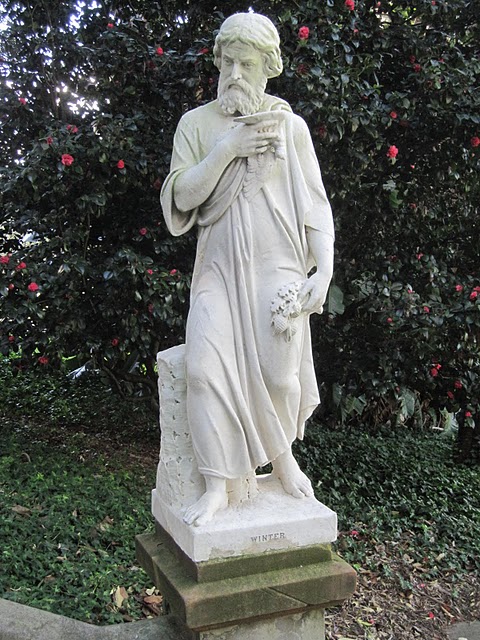 ‘Winter’ is a Victorian era sculpture located in the Royal Botanic Gardens. It is one of the ‘Four Seasons’ statues that adorn the Palace Gardens Steps. They were shipped from Italy in 1883 from the studio of Charles Francis Summers, an Australian-born sculptor living in Rome. The statues were originally located here but then were separated and distributed around the gardens where some lost vital body parts and adornments. Australian sculptor Jacek Luszczyk restored them by recreating the missing parts and the restored statues were unveiled in their original location in 2010.