 “Wurrungwuri” is a sculpture created by Chris Booth at the Royal Botanic Gardens and unveiled in 2011. The Aboriginal name, Wurrungwuri, means “this side – on this side of the water”. The sculpture consists of two parts. This part is a wave-like sandstone form which appears to emerge from the bedrock below Government House to cascade down the lawn towards Sydney Harbour. It is an evolving piece of art where native flora and fauna can make it their home, while it pays deep respect to the Cadigal, the traditional Aboriginal custodians. The Johnson Estate Sculpture was a gift to Sydney by a keen art lover, who committed the bulk of his estate for a sculpture overlooking Sydney Harbour. Click here to view all participants of Outdoor Wednesday Click here to view all participants of Watery WednesdayPosted byJ Barat12:00 AM
 “Sydney Ice Bear” was an ice sculpture of a male polar bear that was located in Customs House Square. It was carved by British sculptor Mark Coreth for World Environment Day to highlight the human impact on our environment and to create awareness of climate change. This happened to coincide with the Vivid Sydney festival, so it had quite a spectacular backdrop at night with the light projections on Customs House that I featured yesterday. I featured some daytime shots of the sculpture here.
 This artwork was installed on the Circular Quay foreshore, as part of the Vivid Sydney festival. “C/C” is a futuristic and functional sculpture created by Singapore’s Angela Chong. It is made from acrylic sheets fashioned into a public bench, illuminated by night with low energy, colour changing LED lights. The shots from the front have the Sydney Opera House as a backdrop, while those from behind look out towards Circular Quay and the city skyline.
 The Venus Fountain statue sits in the Main Pond of the Royal Botanic Gardens. The original sculpture was erected prior to 1880, leading up to the International Exhibition. The base of the fountain was surrounded by weathered rocks and large clam shells, which were later replaced by a sculpted crocodile. The badly deteriorating statue was removed in August 1990 and cast in bronze. It was installed in the pond in September 1994 but the original was lost in the process.
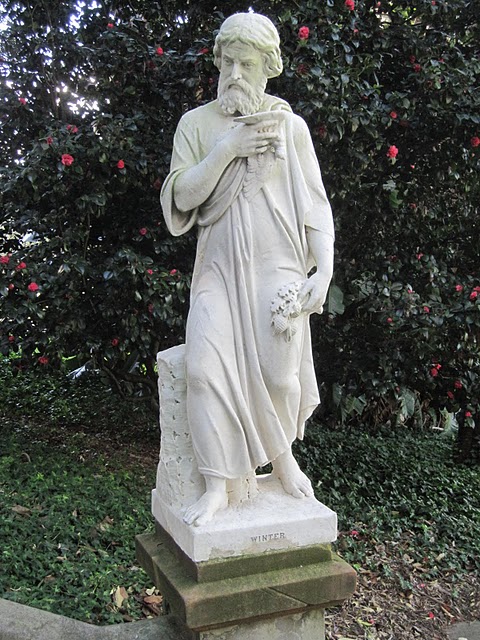 ‘Winter’ is a Victorian era sculpture located in the Royal Botanic Gardens. It is one of the ‘Four Seasons’ statues that adorn the Palace Gardens Steps. They were shipped from Italy in 1883 from the studio of Charles Francis Summers, an Australian-born sculptor living in Rome. The statues were originally located here but then were separated and distributed around the gardens where some lost vital body parts and adornments. Australian sculptor Jacek Luszczyk restored them by recreating the missing parts and the restored statues were unveiled in their original location in 2010.
 This animated sculpture was suspended above the Circular Quay foreshore at the Overseas Passenger Terminal for the Vivid Sydney festival. “The Light Wheel” was created by Australia’s Andre Kecskes and Mark Hammer. It is a play on the sun as the source of light, with LED lamps creating a mass of moving patterns which cycle through the colour spectrum with pulses and ripples throughout the evening. The sculpture runs entirely off one 10 amp outlet.
 Sydney Ice Bear was an ice sculpture of a male polar bear that was located in Custome House Square this week. British sculptor Mark Coreth carved out the life-sized melting ice sculpture of a polar bear on Friday (top). By Monday, the sculpture had melted away to reveal a bronze skeleton (bottom). The display was timed to coincide with World Environment Day on Sunday, as a metaphor for the human impact on our environment and to create awareness of climate change. This is the sixth Ice Bear Project carving following on from those in London, Copenhagen, Montreal, Toronto and Manchester.