 is located in Sydney Harbour, at the junction of Darling Harbour and close to the suburb of Balmain East. The island has been has served as a sandstone quarry, convict stockade, explosives store, police station, fire station, boatyard and film set. This view is from Ballast Point at Birchgrove. The Sydney Harbour Bridge can be seen in the background, behind the island. It was known as Memill by indigenous people and there is considerable debate about how the name was derived. One interpretation is that early settlers thought, if viewed from the air, it may appear to look like a goat.
 A view of Jones Bay Wharf, in the inner city suburb of Pyrmont, with Barangaroo and the Sydney Harbour Bridge in the distance. Jones Bay Wharf consists of Piers 19-21 of Pyrmont Wharves. This marina on Jones Bay sits beside Pier 21. The wharf and warehouse buildings were originally built in 1919, as part of Sydney’s port facilities. After those port facilities were relocated to Port Botany, the buildings were redeveloped in 2003 into commercial space.
 This contemporary sun shelter over these benches is located in Ballast Point Park at Birchgrove. It’s designed to provide shade when the sun is at its harshest, in the middle of the day, yet still provides views of the sky. The benches provide spectacular views over Mort Bay and Sydney Harbour, with Goat Island and the Sydney Harbour Bridge in the distance.
 This contemporary sun shelter over these benches is located in Ballast Point Park at Birchgrove. It’s designed to provide shade when the sun is at its harshest, in the middle of the day, yet still provides views of the sky. The benches provide spectacular views over Mort Bay and Sydney Harbour, with Goat Island and the Sydney Harbour Bridge in the distance.
 The Sydney Opera House and Sydney Harbour Bridge at sunset. This view across Sydney Harbour is from Mrs Macquarie’s Chair.Click here to view thumbnails for all participants of this theme day.
 This artwork near the water’s edge of Campbells Cove at The Rocks, with a spectacular backdrop of the Sydney Harbour Bridge, was installed for the Vivid Sydney festival. “Ember”, created by Joe Snell was a 30 metre long glowing installation that pulsates between red and orange. It evokes the beauty of dying embers and the danger in the potential of an ’ember attack’ that is synonymous with Australian bush fires. It tantalises with its warm ambience on a winter’s night, drawing you closer to touch the glowing coals. It also doubled up as a bench for the audience of the Fire Dance performance every hour.
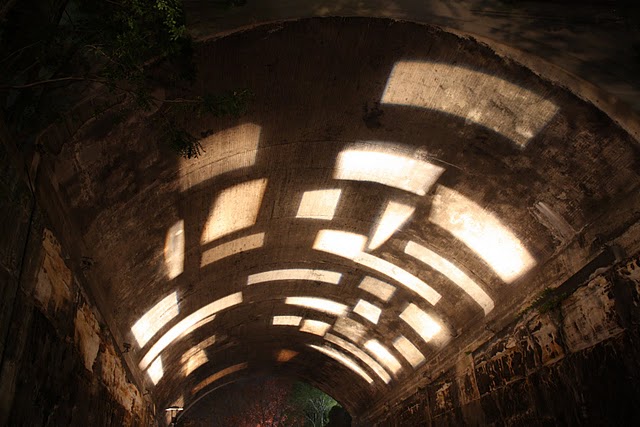 This bridge (top), which sits above the Argyle Cut in The Rocks, carries a roadway, railway, walkway and cycleway from the central business district to the Sydney Harbour Bridge. The Argyle Cut was hewn out of the sandstone ridge of The Rocks to connect Sydney Cove with Darling Harbour and Millers Point. It was started in 1843 by convicts with hammers and chisels but was not completed until 1859 with the use of city council labour and explosives. “Argyle Cut”, created by Mark Dyson, was a geometric pattern of lights displayed on the historic arch (bottom) as part of the Vivid Sydney festival.
Older Posts